Nasal tip projection
-What it is and how to measure it:

Nasal tip projection (see diagram) assesses how far out from the face the tip of the nose protrudes. There are several accepted methods of measuring nasal tip projection, but the most common one described is the Goode method.First the alar line is drawn, which is a line running perpendicular to the Frankfort plane. The alar line runs thru the alar-facial crease, which is where the nasal base attaches to the cheek (see dashed line). A measurement is then taken from the nasal tip to the alar line (“A” in the diagram) and compared to the distance from the nasal tip to the nasal starting point (“B” in the diagram). The ratio of “A” to “B” is a measure of tip projection and should ideally be 0.55-0.60 in most patients. When this ratio is higher than ideal (tip of the nose is positioned too far from the face), the nose is considered overprojected. When the opposite exists and the ratio is lower than ideal (tip of the nose too close to the face), the nose is considered underprojected.
Goode's method diagram:
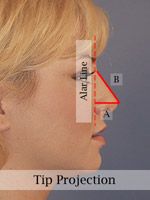
Illustration of both methods:

Your nose is also overprojected if your SDLNT (Sagittal distance from lip to nose tip) makes more than 60% of the whole sagittal length of the nose and/or if your SDLNT measures more than 2 cm.


A low radix accentuates the appearance of an overprojected nose.
-How to fix an overprojected nose:
Nasal Tip Deprojection
www.drhilinski.com

Algorithm developed to help simplify the approach to deprojection.
Analysis begins with evaluation of the radix. Asterisk indicates that full-transfixion incision can be added to these procedures to allow further retrodisplacement. MCO indicates medial crural overlay; LCO, lateral crural overlay.

-Before & Afters:


A low radix can be fixed with a radix graft, an implant or fillers such as Radiesse.


Jaw surgery could make the nose look less overprojected as well:
Some more in-depth information regarding this: